AMD addresses community concerns and confusion surrounding the release of its AMD Software: Adrenalin Edition 25.10.2 driver update, reaffirming its unwavering commitment to supporting all Radeon GPU users across generations. The company clarifies that this update does not signal the end of support for older Radeon RX 5000 and RX 6000 series graphics cards, which are based on the RDNA 1 and RDNA 2 architectures. Instead, AMD has introduced two dedicated driver paths to optimize experiences for different hardware generations: one stable branch tailored specifically for RDNA 1 and RDNA 2 GPUs, and another focused on accelerating new features for the more recent RDNA 3 and RDNA 4 architectures (encompassing the RX 7000 and RX 9000 series).
This separation of driver branches is designed to provide a smoother, more consistent gaming experience for owners of older Radeon cards by leveraging years of accumulated tuning and optimizations, while shielding them from the rapid, experimental changes aimed at cutting-edge hardware. Under this new structure, RDNA 1 and RDNA 2 GPUs will continue to receive essential updates, including game support for new releases, enhancements for stability and performance optimizations tailored to current and upcoming titles, as well as critical security patches and bug fixes to ensure reliable operation. AMD emphasizes that these older architectures remain fully capable for modern gaming, and the dedicated branch will help maintain their peak performance without unnecessary disruptions.
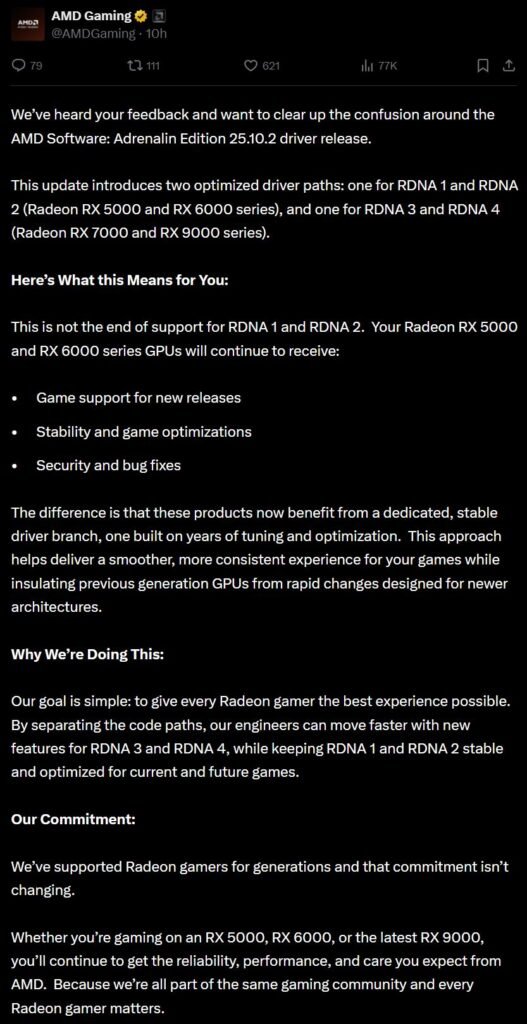
The decision to bifurcate the driver paths stems from AMD’s goal to streamline development processes, allowing its engineering teams to innovate more swiftly on advanced features for RDNA 3 and RDNA 4 while preserving the reliability of legacy support. This approach, AMD explains, enables faster delivery of enhancements that benefit the latest GPUs without compromising the foundational stability that Radeon users on RX 5000 and RX 6000 series have come to expect. The blog post directly responds to feedback from the gaming community, including discussions sparked by recent driver announcements and analyses from outlets like Gamers Nexus, where some users expressed worries about premature discontinuation of support. By framing the changes as an evolution rather than a reduction in service, AMD aims to dispel any misconceptions and highlight how user input has shaped these improvements.
Ultimately, the announcement underscores AMD’s long-standing dedication to the entire Radeon ecosystem, stating that “we’ve supported Radeon gamers for generations and that commitment isn’t changing.” Whether gaming on an RX 5000, RX 6000, RX 7000, or the brand-new RX 9000 series, every user can anticipate the same level of reliability, performance boosts, and attentive care from AMD. The company positions this as a unified effort within the broader gaming community, where “every Radeon gamer matters,” ensuring that no one is left behind as technology advances. This proactive clarification comes amid growing scrutiny on hardware lifecycle support in the PC gaming space, positioning AMD as responsive to its audience’s needs.
Source: AMD Gaming