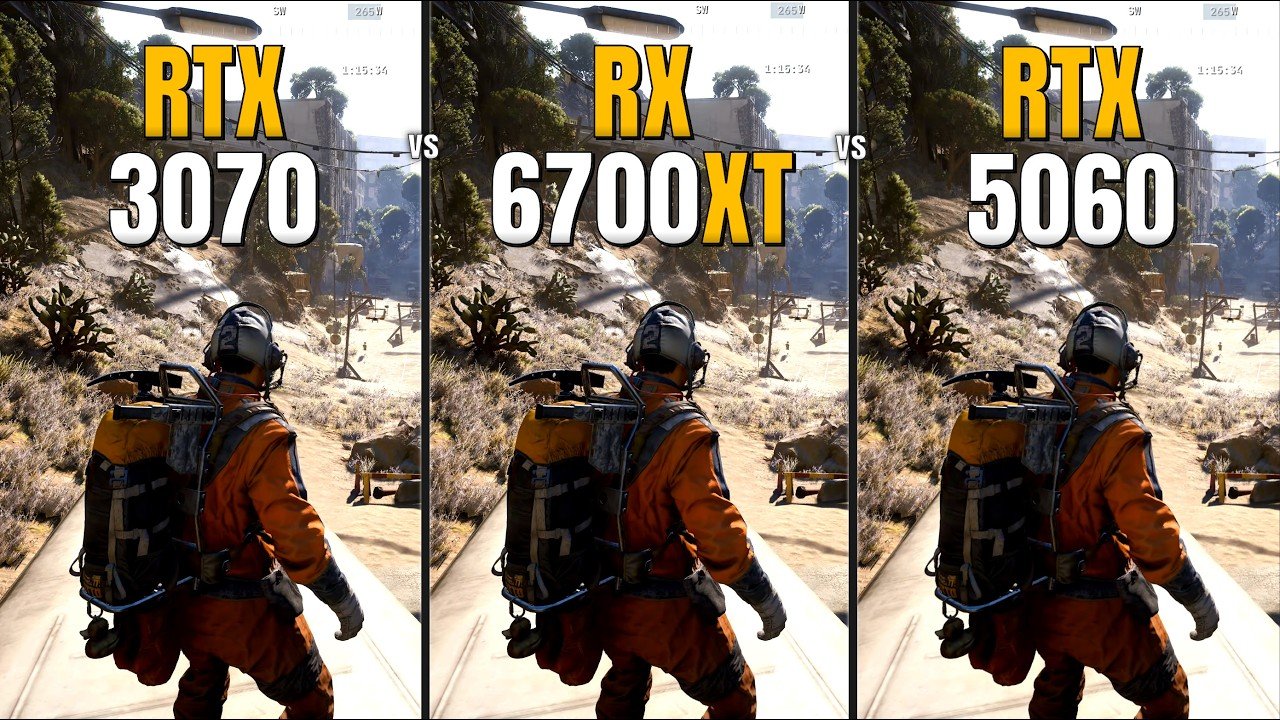
In this article, we compare the RTX 3070 (8GB) , RX 6700 XT (12GB), and RTX 5060 (8GB) across 12 of the latest and most popular games in 2026. I tested all three GPUs to check their raw performance without using any upscaling or frame generation features, focusing only on native gameplay. This gives a clear idea of how each card actually performs in real gaming situations, based on average FPS and overall consistency across different titles. Additionally, we have included detailed specifications and information on each graphics card, giving gamers the insights needed to make informed decisions for modern mid-range gaming builds.
In This Article
Toggle丨NVIDIA GeForce RTX 5060 Overview
The NVIDIA GeForce RTX 5060 was launched on May 19 2025 with an initial manufacturer suggested retail price of $299 USD at launch. It is a desktop graphics processing unit in NVIDIA’s GeForce RTX 50-series, intended for mainstream PC users and gamers seeking balance between cost and graphical capability. The card is built on the Blackwell architecture with the GB206 GPU, and it supports technologies such as DirectX 12 Ultimate, NVIDIA DLSS 4, Multi Frame Generation, NVIDIA Reflex 2, and PCI Express Gen 5 connectivity, along with standard display feature support including HDMI and DisplayPort outputs.
Specifications
In terms of specifications, The RTX 5060 has 3840 CUDA cores, 8 GB of GDDR7 memory on a 128‑bit interface, a base clock around 2.28 GHz and boost clock around 2.50 GHz, 30 ray tracing cores, 120 tensor cores, a total graphics power (TGP) of 145 W, and support for APIs such as Vulkan 1.4 and OpenGL 4.6, with display resolutions up to 4K at high refresh rates.
丨NVIDIA GeForce RTX 3070 Overview
The NVIDIA GeForce RTX 3070 launched on October 29, 2020, with a starting price of $499 USD. It is a desktop graphics card in the GeForce RTX 30‑series, designed for users who want a balance of performance for gaming and graphics tasks. The card is based on NVIDIA’s Ampere architecture with the GA104 GPU, and it supports features such as DirectX 12 Ultimate, DLSS, NVIDIA Reflex, NVIDIA Broadcast, and PCI Express Gen 4.
Specifications
The GeForce RTX 3070 comes with 5888 CUDA cores and 8 GB of GDDR6 memory on a 256‑bit interface. Its base clock is approximately 1.50 GHz, with a boost clock of around 1.73 GHz. The card includes 2nd generation ray tracing cores and 3rd generation tensor cores, has a total graphics power of 220 W, supports Vulkan and OpenGL APIs, and can output a maximum digital resolution of 7680×4320 across multiple displays.
丨AMD Radeon RX 6700 XT Overview
The AMD Radeon RX 6700 XT was released in 18 March 2021 with an initial manufacturer suggested retail price of $479 USD at launch. It is a desktop graphics card in AMD’s Radeon RX 6000 series, designed for PC users and gamers seeking mainstream performance in graphics‑intensive applications. The card is built on the RDNA 2 architecture with the Navi 22 XT GPU and supports technologies including DirectX 12 Ultimate, Vulkan, OpenGL, and PCIe 4.0 connectivity, along with standard display outputs such as HDMI 2.1 and DisplayPort 1.4a.
Specifications
The AMD Radeon RX 6700 XT Comes with 2560 shader cores, 40 ray tracing cores, 12 GB of GDDR6 memory on a 192‑bit interface, base and boost clock speeds around 2321 MHz and 2581 MHz respectively, 230 W total board power (TDP), and additional features like AMD Infinity Cache and support for AMD FidelityFX and Smart Access Memory.
丨RTX 5060 vs RX 6700 XT vs RTX 3070 Specs Comparison
Compare NVIDIA’s RTX 5060 (8GB) vs RX 6700 XT (12GB) vs RTX 3070 (8GB) in a detailed side-by-side analysis. This comparison covers GPU architecture, CUDA and stream processors, memory capacity, clock speeds, ray tracing and AI capabilities, power consumption, connectivity, release date, MSRP, and current pricing.
Name |
Geforce RTX 5060 |
Geforce RTX 3070 |
Radeon RX 6700 XT |
|---|---|---|---|
GPU Name
|
GB206
|
GA104
|
Navi 22
|
Architecture
|
Blackwell 2.0
|
Ampere
|
RDNA 2.0
|
Memory Size
|
8GB
|
8GB
|
12GB
|
Memory Type
|
GDDR7
|
GDDR6
|
GDDR6
|
Memory Bus
|
128 bit
|
256 bit
|
192 bit
|
Bandwidth
|
448.0 GB/s
|
448.0 GB/s
|
384.0 GB/s
|
Base Clock
|
2280 MHz
|
1500 MHz
|
2321 MHz
|
Boost Clock
|
2497 MHz
|
1725 MHz
|
2581 MHz
|
Memory Clock
|
1750 MHz
28 Gbps effective
|
1750 MHz
14 Gbps effective
|
2000 MHz 16 Gbps effective
|
Shading Units
|
3840
|
5888
|
2560
|
TMUs
|
120
|
184
|
160
|
ROPs
|
48
|
96
|
64
|
SM Count
|
30
|
46
|
40
|
Tensor Cores
|
120
|
64
|
160
|
RT Cores
|
30
|
46
|
40
|
TDP
|
145 W
|
220 W
|
230 W
|
Suggested PSU
|
300 W
|
550 W
|
550 W
|
Interface
|
PCIe 5.0 x8
|
PCIe 4.0 x16
|
PCIe 4.0 x16
|
Display Outputs
|
1× HDMI 2.1b, 3× DisplayPort 2.1b
|
1x HDMI 2.1, 3x DisplayPort 1.4a
|
1x HDMI 2.1, 3x DisplayPort 1.4a
|
Release Date
|
May 19th, 2025
|
Oct 29th, 2020
|
Mar 3rd, 2021
|
Launch Price
|
299 USD
|
499 USD
|
479 USD
|
Market price
| |||
Market price
|
The NVIDIA GeForce RTX 5060, GeForce RTX 3070, and AMD Radeon RX 6700 XT are all desktop graphics cards, with the RTX 5060 using GDDR7 memory, the RTX 3070 using GDDR6, and the RX 6700 XT also using GDDR6. Memory sizes are 8 GB for the RTX 5060 and RTX 3070, and 12 GB for the RX 6700 XT, with bus widths of 128‑bit, 256‑bit, and 192‑bit, giving bandwidths of 384–448 GB/s. Clock speeds vary, with the RTX 5060 having a base of 2280 MHz and boost of 2497 MHz, the RTX 3070 at 1500 MHz base and 1725 MHz boost, and the RX 6700 XT at 2321 MHz base and 2581 MHz boost. The RTX 3070 has the most shading units and ROPs, while the RX 6700 XT has more tensor cores than the RTX 3070 but fewer RT cores than the RTX cards. Power requirements range from 145 W to 230 W, with recommended PSUs from 300 W to 550 W. All cards support PCIe and multiple display outputs, with launch dates in October 2020, March 2021, and May 2025, and prices at $499, $479, and $299 respectively.
RTX 5060 vs RX 6700 XT vs RTX 3070 Performance Comparison
丨12 Games Tested
Before diving into the results, we’ve also published a comprehensive Crimson Desert PC performance test covering 12 GPUs, optimized settings, and detailed analysis of DLSS, DLAA, and FSR Native AA. For this test, We tested the RTX 3070, RX 6700 XT, and RTX 5060 in 12 of the latest and most popular games in 2026, focusing only on native performance without using any upscaling or frame generation features. The goal was to see how these GPUs perform in real gaming situations, based on raw frame rates and overall consistency. The RTX 3070 and RX 6700 XT have been common mid-range options for several years, while the RTX 5060 is a newer release, so this test shows how they compare under the same conditions. For a complete breakdown, including real-time gameplay and detailed results, you can watch the full benchmark video on our YouTube channel.
丨Testing System
The test system was built using a GIGABYTE Z790 Gaming X AX DDR5 motherboard paired with an Intel Core i5 12400F processor. Memory configuration included G.SKILL Trident Z5 32 GB (2×16 GB) DDR5 running at 6000 MHz with CL30 timings. Storage consisted of a Samsung 850 EVO 1 TB SSD along with an XPG S40G 512 GB M.2 NVMe drive. The system was powered by an XPG Pylon 650 W 80 Plus Bronze power supply. All the GPUs were tested on this same setup with optimized settings to keep the results fair and consistent.
Component |
Model / Specification |
Check Prices | |
|---|---|---|---|
CPU
|
Intel Core i5 12400f
| ||
Motherboard
|
GIGABYTE Z790 Gaming X AX DDR5
| ||
RAM
|
G. SKILL Trident Z5 2x16GB DDR5 6000mhz
| ||
Power Supply
|
XPG Pylon 650w 80 Plus Bronze
| ||
Storage
|
Samsung 850Evo 1TB SSD
| ||
M.2 Storage
|
XPG S40G 512GB RGB M.2
| ||
Operating System
|
Windows 10 - Version 22H2
| ||
Benchmark Performance Comparison
Game Names |
RTX 3070 (8GB) |
RX 6700 XT (12GB) |
RTX 5060 (8GB) |
|---|---|---|---|
Battlefield 6
|
AVG FPS : 81
|
AVG FPS : 78
|
AVG FPS : 73
|
Clair Obscur Expedition 33
|
AVG FPS : 48
|
AVG FPS : 44
|
AVG FPS : 47
|
Kingdom Come Deliverance 2
|
AVG FPS : 53
|
AVG FPS : 42
|
AVG FPS : 51
|
Mafia The Old Country
|
AVG FPS : 43
|
AVG FPS : 41
|
AVG FPS : 43
|
Stalker 2: Heart Of Chornobyl
|
AVG FPS : 61
|
AVG FPS : 53
|
AVG FPS : 67
|
The Last Of Us Part 1
|
AVG FPS : 78
|
AVG FPS : 81
|
AVG FPS : 74
|
The Last Of Us Part 2
|
AVG FPS : 71
|
AVG FPS : 56
|
AVG FPS : 60
|
Cyberpunk 2077
|
AVG FPS : 63
|
AVG FPS : 56
|
AVG FPS : 66
|
Silent Hill F
|
AVG FPS : 44
|
AVG FPS : 40
|
AVG FPS : 42
|
God Of War Ragnarok
|
AVG FPS : 91
|
AVG FPS : 75
|
AVG FPS : 88
|
Arc Raiders
|
AVG FPS : 78
|
AVG FPS : 72
|
AVG FPS : 80
|
Alan Wake 2
|
AVG FPS : 46
|
AVG FPS : 37
|
AVG FPS : 43
|
The benchmark results across 12 games show that performance varies depending on the title, but some clear trends can be seen between the RTX 3070, RX 6700 XT, and RTX 5060. The RTX 3070 takes the lead in most games, including Battlefield 6, Clair Obscur Expedition 33, Kingdom Come Deliverance 2, The Last of Us Part 2, Silent Hill F, God of War Ragnarok, and Alan Wake 2, showing steady performance across different types of games. The RTX 5060 performs better in Stalker 2, Cyberpunk 2077, and Arc Raiders, and matches the RTX 3070 in Mafia The Old Country, showing stronger results in some newer titles. The RX 6700 XT only leads in The Last of Us Part 1, and in most other games it stays behind the other two GPUs.
✦ Overview
Overall, the RTX 3070 delivers the most consistent performance across the majority of tested games, making it the leading option in this comparison. The RTX 5060 follows closely, with strong results in several newer titles and lower power usage, while the RX 6700 XT leads in limited cases but generally falls behind in most games. The final choice depends on pricing and availability, as all three cards perform differently depending on the workload.

Afaq is the author and driving force behind GAMING BENCH, a technology and gaming focused platform dedicated to delivering accurate, insightful, and up to date coverage of the gaming world. With a strong interest in PC hardware, gaming performance, and industry trends, Afaq focuses on creating clear, well researched content that helps readers understand the latest gaming news, benchmarks, and technology developments. Through GAMING BENCH, the goal is to provide reliable information, honest analysis, and practical insights for gamers, tech enthusiasts, and professionals who want to stay informed in a fast moving digital landscape.