From the technical depth of Death Stranding to the anticipation surrounding Death Stranding 2: On the Beach, this article provides a complete overview of what players need to know. We cover key information about the original release, including game details, official system requirements, and real world benchmark performance across different hardware configurations, followed by a look at the upcoming sequel from Kojima Productions, highlighting its announced details and system requirements so readers can clearly understand what to expect in terms of both gameplay and PC performance.
In This Article
ToggleDeath Stranding 2: On the Beach
Death Stranding 2: On the Beach is a major video game sequel developed by Hideo Kojima and Kojima Productions, and published by Sony Interactive Entertainment. It follows the original Death Stranding with new locations, expanded gameplay, deeper narrative themes about connection and survival in a fractured world, and a high‑profile cast of characters and voice performances.

Overview
Death Stranding 2: On the Beach is a third‑person action‑adventure game blending exploration, combat, logistics and asynchronous social systems. The sequel continues to focus on traversal and delivery mechanics across a hostile, partially open world, while adding more action‑oriented combat and new tools compared to its predecessor.
The game was released first on PlayStation 5 on June 26, 2025 and is scheduled to arrive on Windows PC (Steam and Epic Games Store) on March 19, 2026 with platform‑specific enhancements such as uncapped framerate support, ultrawide monitor support, and advanced upscaler technologies.
Story and Setting
The story begins eleven months after the events of the first Death Stranding, taking Sam Porter Bridges back into a world still reeling from apocalyptic events. Most of the United Cities of America (UCA) are now connected through the chiral network, but BRIDGES as an organization has dissolved, replaced by automated delivery systems that have displaced human porters.
Strange portals known as plate gates begin appearing in areas with high chiral density, linking North America to far‑flung places such as Mexico and Australia, where the majority of the sequel takes place. Sam is recruited by Fragile to reconnect chiral network terminals in Mexico and beyond, offering a pardon for him and his adopted daughter Lou if he succeeds.
In this new world, Beached Things (BTs) have evolved, natural disasters like earthquakes and sandstorms reshape the landscape, and hostile forces including bandits and mysterious “ghost mechs” pose threats that Sam must navigate.
Characters
The sequel brings back key characters from the original:
Sam Porter Bridges, voiced and likeness by Norman Reedus
Fragile, voiced and likeness by Léa Seydoux
Higgs, voiced and likeness by Troy Baker
It also introduces new roles portrayed by Elle Fanning, Shioli Kutsuna, Luca Marinelli, Alastair Duncan, Alissa Jung, Debra Wilson and Tommie Earl Jenkins. In addition, filmmakers like George Miller, Fatih Akin, Guillermo del Toro and Nicolas Winding Refn appear in stylized forms or extended roles, adding to the game’s ensemble.
✦ Gameplay Mechanics
Core Loop
Players once again take on the role of Sam as a porter, tasked with traversing vast regions to deliver packages, materials and reconnection nodes to scattered survivors and settlements. The core challenge is balancing cargo loads, navigating complex terrain, and managing the risks of weather and enemy encounters.
Combat and Tools
Unlike the original, On the Beach features a more robust combat system with new weapons and strategies:
New enemy types, including BT variants like the “watcher” that use sight to hunt Sam.
Human antagonists known as Armed Survivalists who use lethal firearms.
New weapons like electrified poles, holographic grenades that can confuse enemies, and a variety of firearms that enable stealth, ambush, or direct confrontation.
Progression and Skills
Sam’s abilities grow through the Automated Porter Assistant System (APAS), a skill tree that spans categories including porter performance, combat, stealth, service tools, and “bridge link” capabilities that enhance connecting and delivery functions. Skills develop through repeated actions, meaning players improve organically as they play.
Social Strand System
The Death Stranding universe’s signature asynchronous multiplayer system returns. Players can indirectly influence each other’s worlds by leaving structures, tools, and pathways, helping porters worldwide in a shared experience.
Editions and Release
Death Stranding 2: On the Beach launched on PS5 with multiple editions, including Standard, Digital Deluxe, and Collector’s Editions, the latter featuring physical collectibles, early access and bonus in‑game items. Pre‑orders unlocked additional cosmetic and gear items for all versions.
The upcoming PC version brings graphical and performance options tailored for desktop systems, support for mouse and keyboard controls, advanced audio formats, and connectivity features including PlayStation integration for PC players.
Music and Audio
The soundtrack combines compositions from Woodkid and Ludvig Forssell, incorporating procedural music that adapts dynamically to gameplay. The soundtrack also features licensed tracks from artists including Low Roar, Silent Poets, Caroline Polachek, Magnolian, Hania Rani, and Daichi Miura, contributing to the emotional ambience that complements the narrative and exploration.
Themes and Impact
Kojima revised the narrative substantially from earlier draft versions to encapsulate themes shaped by recent global experiences such as the COVID‑19 pandemic, focusing on human connection and the consequences of isolation. The title continues to explore philosophical questions about connectivity, humanity, and the interplay of technology and society, all threaded through a unique blend of gameplay, storytelling and social interaction.
Death Stranding 2: On the Beach - System Requirements
Here are the official PC specifications for Death Stranding 2: On the Beach, based on the confirmed requirements announced ahead of its March 19, 2026 PC release. These cover multiple performance targets so you can match your system to the resolution and frame rate you want.
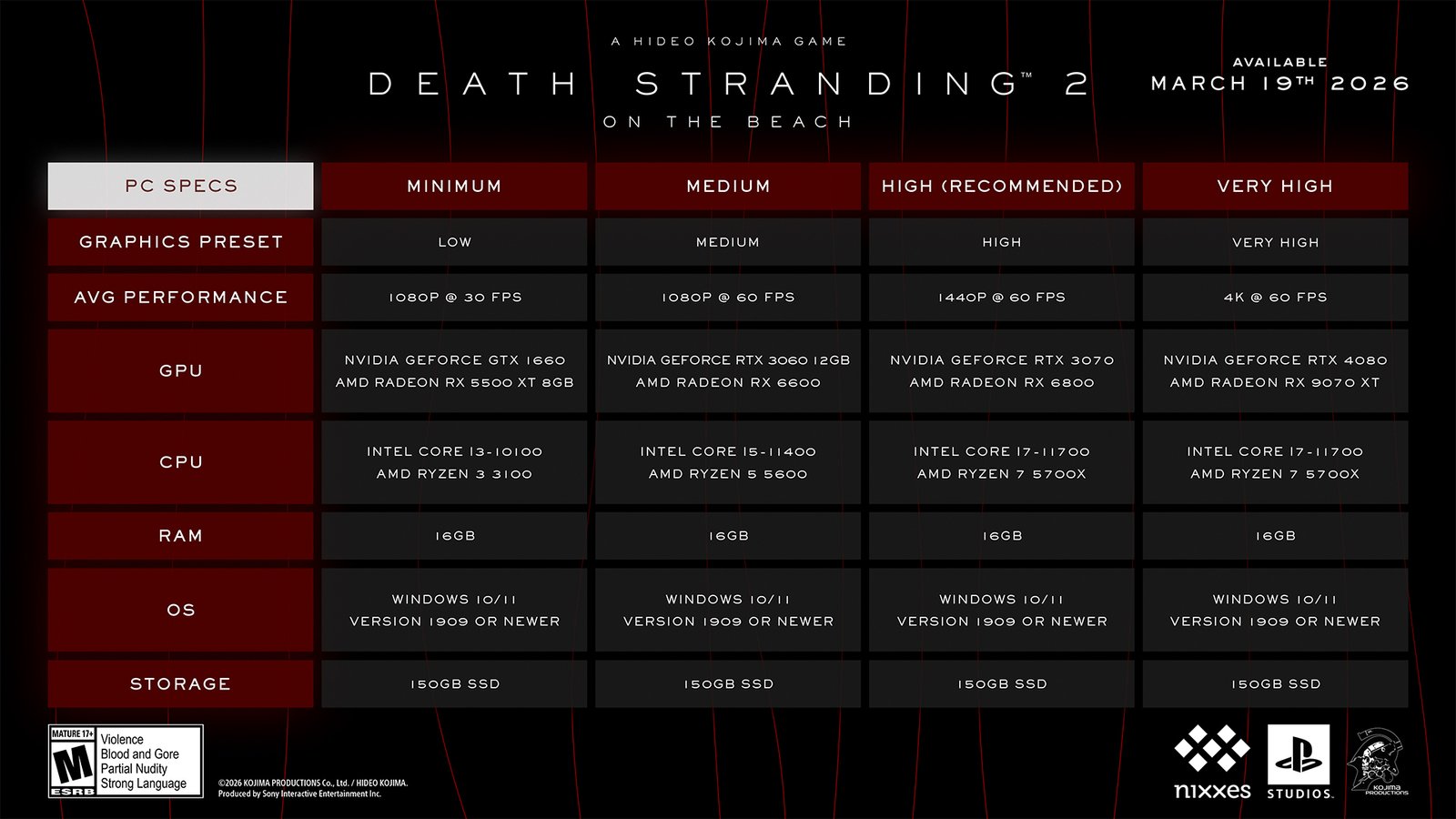
Minimum Requirements
Graphics Preset: Low
Avg Performance: 1080p @ 30 FPS
OS: Windows 10/11 (Version 1909 or newer)
Processor: Intel Core i3-10100 / AMD Ryzen 3 3100
Graphics: NVIDIA GeForce GTX 1660 / AMD Radeon RX 5500 XT 8GB
Memory: 16GB RAM
Storage: 150GB SSD
Medium Requirements
Graphics Preset: Medium
Avg Performance: 1080p @ 60 FPS
OS: Windows 10/11 (Version 1909 or newer)
Processor: Intel Core i5-11400 / AMD Ryzen 5 5600
Graphics: NVIDIA GeForce RTX 3060 12GB / AMD Radeon RX 6600
Memory: 16GB RAM
Storage: 150GB SSD
High Requirements
Graphics Preset: High
Avg Performance: 1440p @ 60 FPS
OS: Windows 10/11 (Version 1909 or newer)
Processor: Intel Core i7-11700 / AMD Ryzen 7 5700X
Graphics: NVIDIA GeForce RTX 3070 / AMD Radeon RX 6800
Memory: 16GB RAM
Storage: 150GB SSD
Very High Requirements
Graphics Preset: High
Avg Performance: 4K @ 60 FPS
OS: Windows 10/11 (Version 1909 or newer)
Processor: Intel Core i7-11700 / AMD Ryzen 7 5700X
Graphics: NVIDIA GeForce RTX 4080 / AMD Radeon RX 9070 XT
Memory: 16GB RAM
Storage: 150GB SSD
Performance & Features on PC
Beyond raw specs, the PC release supports advanced enhancements that improve visual quality and performance:
NVIDIA DLSS 4, AMD FSR 4 and Intel XeSS 2 upscaling to boost frame rates with minimal quality loss.
Guerrilla’s Pico upscaler from the Decima engine, compatible with all supported GPUs.
Uncapped framerates for gameplay (cinematics remain locked at 60 FPS).
Ultrawide support: 21:9 for cutscenes, up to 32:9 for gameplay, and widescreen options even on 16:9 monitors.
Full keyboard & mouse controls, plus DualSense controller integration with adaptive triggers and haptic feedback.
Comparison PC Requirements of Death Stranding 1 and Death Stranding 2
Feature |
Death Stranding 1 |
Death Stranding 2 |
|---|---|---|
Low Preset
|
GTX 1050 / RX 560 4GB, 1080p suggested, Low Graphics
|
GTX 1660 / RX 5500 XT 8GB, 1080p @ 30 FPS, Low preset
|
Medium Preset
|
GTX 1060 / RX 590, 1080p, Medium Graphics
|
RTX 3060 / RX 6600, 1080p @ 60 FPS, Medium preset
|
Memory
|
8GB RAM Minimum, 8GB Recommended
|
16GB RAM minimum for all presets
|
Storage
|
80GB
|
150GB
|
CPU
|
i5-3470 / Ryzen 3 1200 Minimum, i7-3770 / Ryzen 5 1600 Recommended
|
i3-10100 / Ryzen 3 3100 Minimum, i5-11400 / Ryzen 5 5600 Medium Preset
|
When comparing the PC requirements of Death Stranding 1 and Death Stranding 2, both games use 1080p as the baseline resolution for low and medium settings, but DS2 is significantly more demanding. For minimum or low settings, DS1 can run on a GTX 1050 or RX 560 with 8GB RAM, while DS2 requires a GTX 1660 or RX 5500 XT with 16GB RAM to achieve 1080p at 30 FPS. At medium or recommended settings, DS1 runs well on a GTX 1060 or RX 590, targeting around 60 FPS, whereas DS2 needs a modern GPU like the RTX 3060 or RX 6600 with 16GB RAM to hit 1080p at 60 FPS. In terms of CPU, DS2’s minimum and medium requirements are slightly higher than DS1’s, reflecting its heavier performance demands. Overall, while the resolution and FPS targets are similar, DS2 requires newer, more powerful hardware, roughly one to two GPU tiers above what was sufficient for DS1, making it a more resource-intensive game even at comparable settings.
Death Stranding 1 Performance Benchmarks
丨3 GPUs Benchmarks
When the Death Stranding came out on November 8, 2019, we tested it right away on Three different graphics cards. We checked how the game ran at 1080p and 720p. Each graphics card was tested on Low settings. You can watch our full benchmark videos on YouTube to see the results across all resolutions and settings. We have uploaded Three separate videos, each covering a different GPU or configuration.
丨Testing System
We tested Death Stranding across three different GPUs, evaluating frame rates, thermal performance, and overall stability. The test system was equipped with an I7 860 2.80Ghz 1ST GEN processor, 8GB 1333mhz RAM, and a 450W branded power supply.
Component |
Model / Specification |
|---|---|
CPU
|
I7 860 2.80Ghz 1ST GEN
|
RAM
|
8GB 1333mhz
|
Power Supply
|
450w Branded PSU
|
Operating System
|
Windows 10
|
Benchmark Performance Summary
GPU Model |
Graphic Settings |
Avg FPS |
|---|---|---|
R7 260x (2GB)
|
720P Low
|
46 FPS
|
R7 240 (2GB)
|
720P Low
|
16 FPS
|
GT 1030 (2GB)
|
720P Low
|
39 FPS
|
Death Stranding Fails on GT 710 and R7 240
When attempting to run Death Stranding on entry level GPUs like the NVIDIA GeForce GT 710 and AMD R7 240, the game fails to launch and displays a DirectX compatibility error. Specifically, users receive a message stating that the NVIDIA GeForce GT 710 does not support the required DirectX 12 features. Since Death Stranding is built around a DirectX 12 rendering pipeline, both the GT 710 and R7 240 lack the necessary feature level support to initialize the game engine, making it unplayable on these older, low end graphics cards.
✦ Graphics Card Performance Overview
The AMD R7 260x (2GB) delivers the best overall gaming performance at low settings. At 1080p resolution, it averages about 25 FPS, which is playable but not perfectly smooth for modern fast-paced titles. Dropping the resolution to 720p significantly improves performance to around 46 FPS, making it the most capable card in this group for entry-level gaming.
The NVIDIA GT 1030 (2GB) performs next best. It reaches 20 FPS at 1080p low, which is below ideal playability, but at 720p low it climbs to 39 FPS, making it reasonable for older or less demanding games.
The AMD R7 240 (2GB) is the lowest performer, delivering just 16 FPS at 720p low, resulting in choppy gameplay that is generally not suitable for most games. In fact, both the R7 240 and the GT 710 fail to run modern titles like Death Stranding, producing errors due to lack of DirectX 12 support, highlighting their limitations for contemporary gaming.

Afaq is the author and driving force behind GAMING BENCH, a technology and gaming focused platform dedicated to delivering accurate, insightful, and up to date coverage of the gaming world. With a strong interest in PC hardware, gaming performance, and industry trends, Afaq focuses on creating clear, well researched content that helps readers understand the latest gaming news, benchmarks, and technology developments. Through GAMING BENCH, the goal is to provide reliable information, honest analysis, and practical insights for gamers, tech enthusiasts, and professionals who want to stay informed in a fast moving digital landscape.